Academic Research
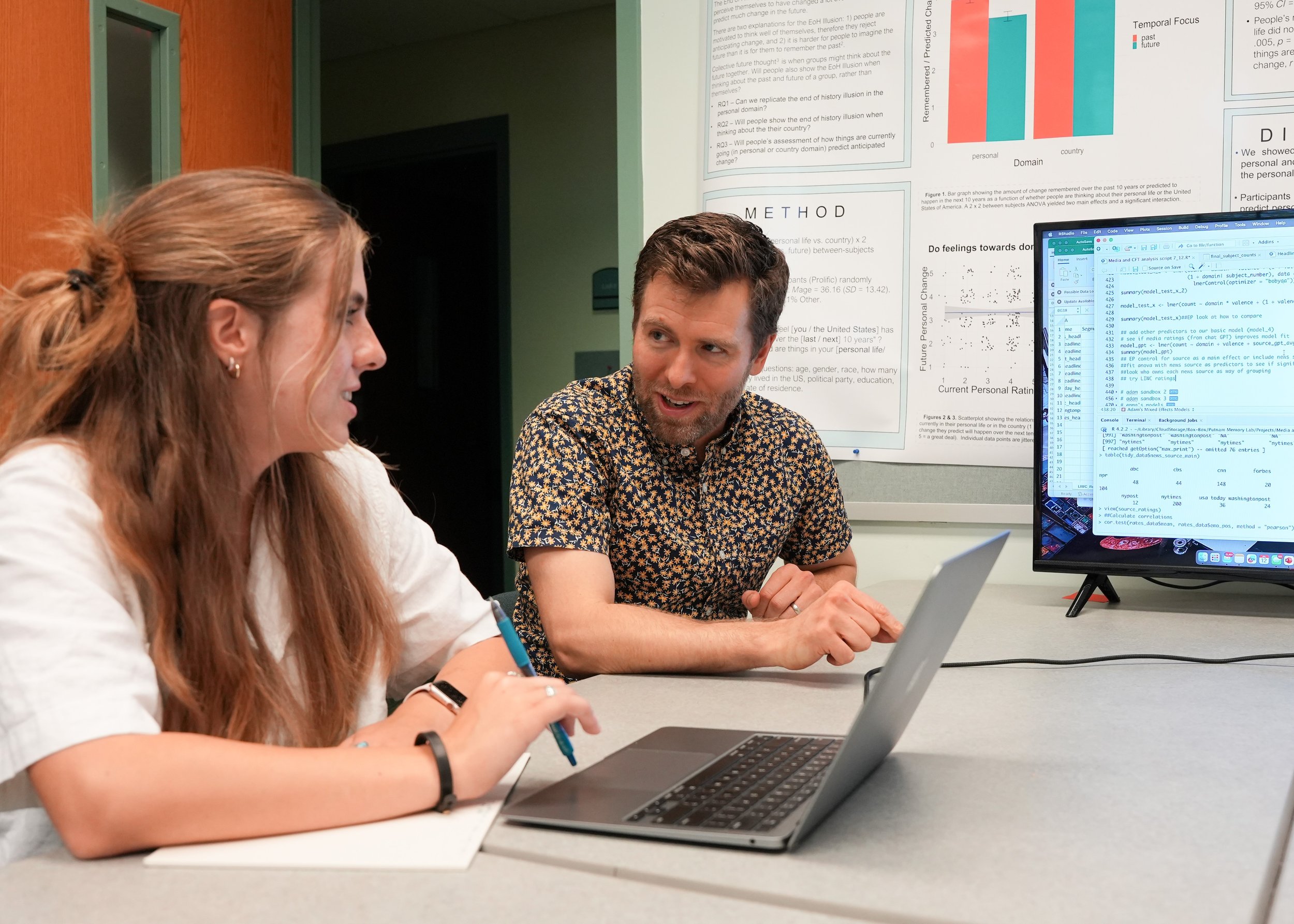
Adam is an active researcher, and frequently publishes papers in psychology's most prestigious journals. His research broadly explores how understanding human cognition—memory, attention, decision-making—can be used to solve real world problems. Specific research areas include applying cognitive psychology to enhance education, false memory formation, and how memory is related to thinking about the future, both in one's personal life and in relation to the groups they belong to.
Publications
Livingston, W. H., Putnam, A. L., & Wamsley, E. J. (2026). The American dream: Election night dreams predict overnight change in feelings about the election and the future. PloS One, 21(9), e0357370. [PDF]
Page, E. R., & Putnam, A. L. (2026). Temporal consistency of collective future thinking. Journal of Applied Research in Memory and Cognition, 15(2), 299-311. [PDF]
Talhelm, T., Wei, L., Sun, R., Medvedev, D., San Martin, A., Helmy, M., Samekin, A., Zaragoza Scherman, A., English, A. S., & The Responsibilism Collaboration Team (2026). Defining collectivism as duties in relationships rather than generalized warmth improves predictive validity in 100 cultures. Nature Human Behaviour. https://doi.org/10.1038/s41562-026-02525-1
Livingston, W. H., Putnam, A. L., & Wamsley, E. J. (2025). The effect of post-learning rest on false memory. Neurobiology of Learning and Memory, 221(108080), 108080. [PDF]
Putnam, A. L., Yamashiro, J. K., Tekin, E., & Roediger, H. L., (2024). Collective overclaiming is related to collective narcissism and numeracy. Memory & Cognition, 54, 840-851. [PDF]
Deng, W., Rosenblatt, A. K., Talhelm, T., and Putnam, A. L. (2023). People from the US and China think about their personal and collective future differently. Memory & Cognition, 51, 87-100 [PDF]
Rinella, H. L., & Putnam, A. L. (2022). The study strategies of small liberal arts college students before and after COVID-19. PLOS One, 17(12): e0278666 [PDF]
Roediger, H. L., Putnam, A. L., & Yamashiro (2022). National and state narcissism as reflected in overclaiming of responsibility. National Memory in a Time of Populism. R. Roediger & J.V. Wertsch, eds. (pp. 209-235). Oxford University Press.
Putnam, A. L., Deng, W., & DeSoto, K. A. (2022). Confidence ratings are better predictors of future performance than delayed judgments of learning. Memory, 30(5), 537-553. [PDF]
Putnam, A. L., Drake, S. M., Wang, S. Y., & DeSoto, K. A. (2021) Collective memory for American leaders: Measuring recognition for the names and faces of the US presidents. PLOS One, 16(7), Article e0255209. [PDF]
Ross, M. Q., Sterling-Maisel, O. A., Tracy, O., & Putnam, A. L. (2020). Overclaiming responsibility in fictitious countries: Unpacking the role of availability in support theory predictions of overclaiming. Memory & Cognition, 48(8), 1346-1358. [PDF]
Putnam, A. L., Ross, M. Q., Soter, L. K., Roediger, H. L., (2018). Collective narcissism: Americans exaggerate the role of their home state in appraising U.S. history. Psychological Science, 29(9), 1414-1422. [PDF]
Zaromb, F. M., Liu, J. H., Páez, D., Hanke, K., Putnam, A. L., Roediger, H. L. (2018). We made history: Citizens of 35 countries overestimate their nation's role in world history. Journal of Applied Research in Memory & Cognition, 7(4), 521-528. [PDF]
Putnam, A. L., & Roediger, H. L. (2018). Education and memory: Seven ways the science of memory can improve classroom learning. In J. T. Wixted (Ed.), The Stevens' Handbook of Experimental Psychology and Cognitive Neuroscience. New York: Wiley. [PDF]
Tauber, S. K., Witherby, A. E., Dunlosky, J., Rawson, K. A., Putnam, A. L., & Roediger, H. L. (2018). Does covert retrieval benefit learning of key term definitions? Journal of Applied Research in Memory and Cognition, 7, 106 - 115. [PDF]
Putnam, A. L., & Phelps, R. J. (2017). The citation effect: In-text citations moderately increase belief in trivia claims. Acta Psychologica, 179, 114 - 123. [PDF]
Putnam, A. L., Sungkhassettee, V., & Roediger, H. L. (2017). When misinformation improves memory: The effects of recollecting change. Psychological Science, 28, 36-46. [PDF]
Putnam, A. L., Sungkhassettee, V., & Roediger, H. L. (2016). Optimizing learning in college: Tips from cognitive psychology. Perspectives on Psychological Science, 11, 652-660. [PDF]
Putnam, A. L., Nestojko, J. F., & Roediger, H. L. (2016). Improving student learning: Two strategies to make it stick. In J. C. Horvath, J. Lodge, & J. A. C. Hattie (Eds.), From the laboratory to the classroom: Translating the science of learning for teachers (pp. 94-121). Oxford, U.K.: Routledge. [PDF]
Putnam, A. L. (2015). Mnemonics in education: Current research and applications. Translational Issues in Psychological Science, 1, 130-139. [PDF]
Putnam, A. L., Wahlheim, C. N., & Jacoby, L. L. (2014). Memory for flip-flopping: Detection and recollection of political contradictions_. Memory and Cognition, 42_, 1198-1210. doi: 10.3758/s13421-014-0419-9 [PDF]
Putnam, A. L., Ozubko, J. D., MacLeod, C. M., & Roediger, H. L. (2014). The production effect in paired associate learning. Memory and Cognition, 42, 409-420. doi: 10.3758/s13421-013-0374-x [PDF]
Putnam, A. L., & Roediger, H. L. (2013). Does response mode affect amount recalled or the magnitude of the testing effect? Memory and Cognition, 41, 36--48. doi:10.3758/s13421-012-0245-x [PDF]
Roediger, H. L., Putnam, A. L., & Smith, M. A. (2011). Ten benefits of testing and their applications to educational practice. In J. Mestre & B. Ross (Eds.), Psychology of learning and motivation: Advances in theory and research (pp. 1-36). Oxford: Elsevier. [PDF]
Peshkam, A., Mensink, M. C., Putnam, A. L., & Rapp, D. N. (2011). Warning readers to avoid irrelevant information: When being vague might be valuable. Contemporary Educational Psychology, 36, 219--231. doi:10.1016/j.cedpsych.2010.10.006 [PDF]
Teaching
Adam is an Associate Professor at Furman University. He teaches classes in Introduction to Psychology, Research Methods, Data Analysis in Psychology, Memory and Cognition, and upper level courses on cognition.
As an instructor, Professor Putnam is praised for cultivating a strong connection with his students, bringing a high-energy and enthusiastic classroom demeanor, and challenging his students to achieve more than they could imagine.